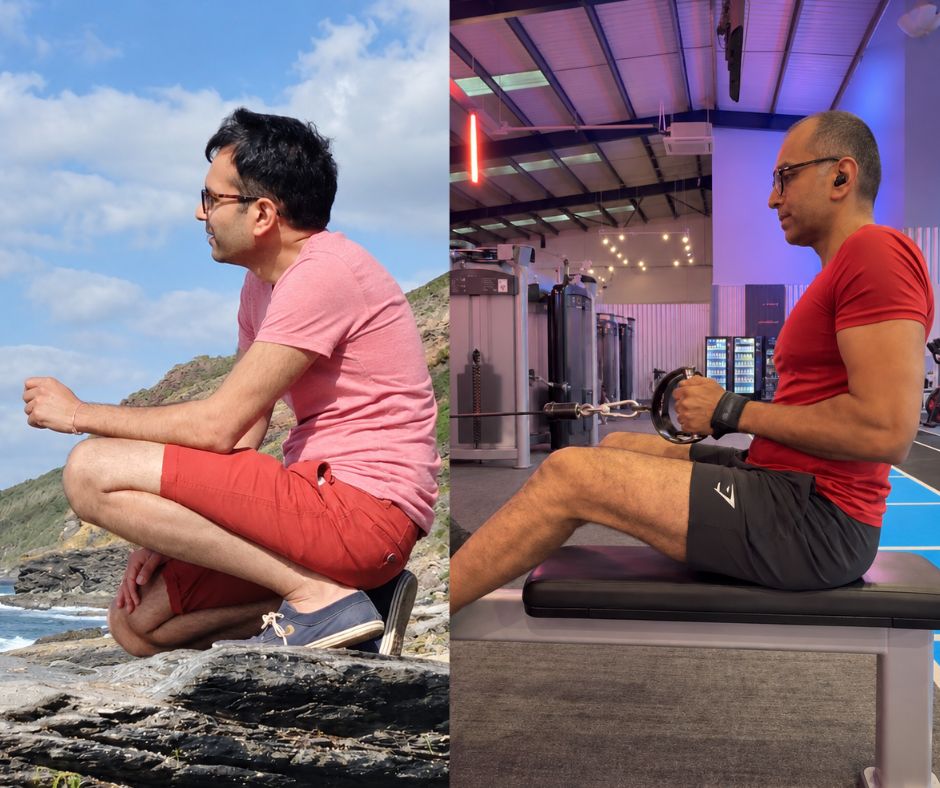
Start: January 2023 - 69.8kg (~154 lbs)
Checkpoint: April 2023 - 62kg (~137 lbs)
Weight lost: 7.8kg (~17 lbs)
3.5 years and counting with RNT
A window cleaner came round to Samir Patel’s house recently, took one look at him and asked if he went to the gym. Samir told him no. His wife was standing next to him.
“My wife looked at me and went, ‘Yeah, you go to the gym every day apart from one day.’ I was like, yeah, no, I do work out.”
“I don’t see myself as someone who works out necessarily, but it’s a huge part of it and I do work out, and I don’t know why I said no.”
Samir is 45, a GP partner and a dad of two. From his teens into his mid-thirties he weighed 62 to 63kg at 5’11”, with very little muscle and the soft middle that comes with being skinny fat. Five years of programmes and online coaches in his thirties hadn’t changed that. On his RNT application at 41, under his reason for joining, he wrote:
“If I see a successful body physically everyday I know then I can achieve big things in life at home and at work. It will give me the confidence to make decisions that I don’t normally feel comfortable with. For example making a career change that perhaps I’m too scared to do over many years.”
After joining in January 2023, he cut to 62kg to strip back the fat, then spent three years building up to 76kg. He has also made that career change, and has started a private lifestyle medicine service in London.
The 5’11” Chap Who Was “Mainly Academic”
Samir grew up watching Arnold Schwarzenegger, Sylvester Stallone and Jean-Claude Van Damme films.
“I sort of looked at those guys and thought, you know, they look good, with the fact that they’ve got muscle. I was never particularly sporty. I was mainly academic.”
“As years went by people assumed I was fit as I was slim but I knew I wasn’t. There is way more to being fit than being slim.”
Medical school took up his twenties. He married, and the children arrived in his late twenties while his career moved forward. By his mid-thirties his wife had started working out, and he decided it was his turn.
“Muscle was something that I wanted to build. It would be nice to get a six pack at some point in my life. It was a big sort of superficial incentive at the time.”
Over the next five years he tried P90X and several online coaching packages, alongside YouTube videos and his own reading. Each package cost more than the last.
“I’d done some YouTube stuff, decided that I needed to eat more protein and those sorts of things, and I’d probably just put on lots of weight and I hadn’t really necessarily put on muscle, which was what I’d really wanted to do.”
Every coach set him 10,000 steps a day. His desk job kept him nearer 3,000.
“My coach would say, listen, you need to get the 10,000 steps in, and I would say, well, I can’t do that. My life is just too busy. I cannot fit it into my life.”
“I was good at tracking nutrition 3 days a week but then over the weekends I wouldn’t. I also didn’t get much feedback from my trainer about my exercise technique or effort levels. Overall, I wasn’t seeing great results and lost confidence in what I was doing.”
“He Had More in Him”
Samir’s dad became seriously ill very suddenly and died within three months of his diagnosis. He was 80. He had kept himself well, going to the gym and walking on the treadmill. He had a bigger frame and more muscle than his son, and apart from mildly high blood pressure he had no real medical problems.
“He did have a good run, but he had more in him, I think, ‘cos it happened so suddenly.”
Samir left the online programme he was on around that time. In his words, “I wasn’t in the right headspace for it.” He only connected his father’s death to his next attempt later, looking back.
“I think when he died, it just puts into perspective the fact that it happens. So what are you going to do to maintain the quality of life that you want for as long as possible?”
“What happened to Dad also made me want to commit to something and make it work.”
Searching for “Skinny Fat Indian Transformations”
In 2022, at 41, Samir went looking online again.
“I think I may have done a search for body transformations or skinny fat, which is what I felt I was. Probably skinny fat Indian transformations, and this whole host of pictures came up, and I looked at them and I just thought, wow, these are incredible. You see lots of people losing weight, but I wasn’t seeing that many people putting on muscle. It was the harder thing to sort of come across.”
He read an awful lot of the education articles on the RNT website.
“I am a scientist by training and I found the articles sensible and based on evidence.”
While Samir was browsing RNT’s Instagram, Akash messaged to ask if he could help. Samir replied that he was just looking, and Akash told him to get in touch in his own time.
“I thought that was really nice. This guy’s not pushy, he’s not said, oh come on, I’ll give you the whole marketing spiel that I was expecting.”
The price gave him pause.
“I looked at RNT and I thought, you know, these guys are quite expensive, but I think this is what I need to do because I haven’t got anywhere with my own journey. Let me commit to it.”
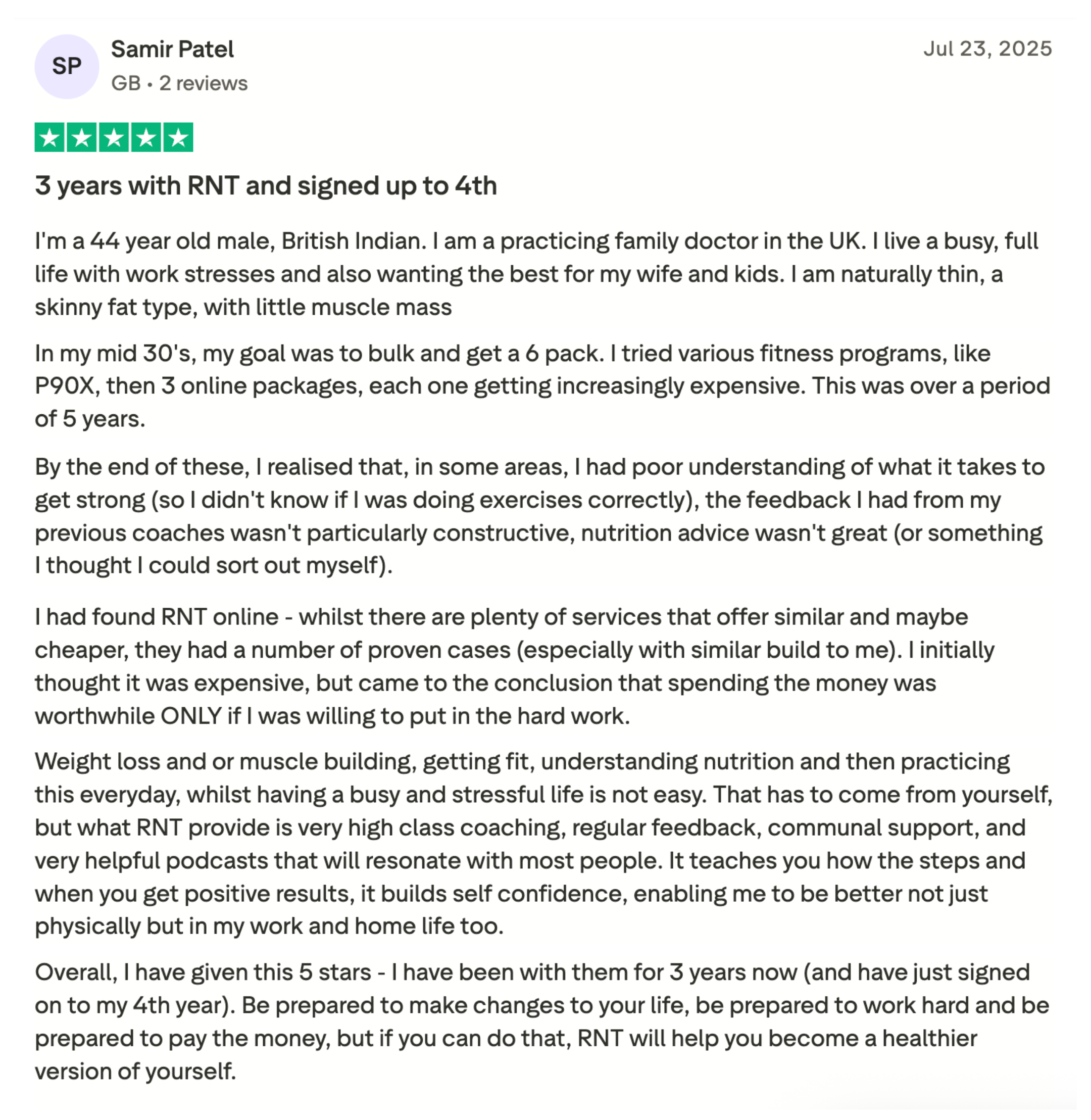
In a Trustpilot review written after three years with RNT, he described the decision.
“I initially thought it was expensive, but came to the conclusion that spending the money was worthwhile ONLY if I was willing to put in the hard work.”
When Akash asked him on the podcast what had nearly stopped him signing up, Samir answered straight away.
“Self-doubt. Just, you know, can I commit to such a thing? Failure probably, knowing that I could fail at it.”
He spent the four months before signing up testing whether he could meet the non-negotiables, starting with the one that had beaten him before.
“I said if I’m gonna make this work, this RNT system seems pretty hardcore, you know, you’ve gotta be on point, you’ve got to commit to it. Test yourself, can I do that. And the biggest test for me was trying to fit steps in.”
On a normal workday he had never got past 3,000 steps. He kept waterproofs, walking shoes and a hat at work, and after his morning’s work he walked for 45 minutes to an hour.
“Basically I didn’t give myself a chance to have any excuses.”
He talked it through with his wife and started in January 2023.
Getting Leaner Before Getting Bigger
For a skinny fat client, the first phase at RNT usually means losing fat before any building starts, so that the muscle gained later isn’t hidden under extra body fat. Samir started on around 1,600 to 1,800 calories a day. He did three resistance sessions a week in his home gym, one cardio session, and his daily steps.
“I wasn’t comfortable with it at the beginning, but when I started to see how quickly the weight was coming off, I didn’t think that there was gonna be a very long process. I would say, look, what are we doing? Is this gonna go on forever? And coach would say no, we’ll start building you soon, but you’re doing a really good job, so it’s not gonna take that long.”
The eating habits he’d had for years also became clearer.
“I’ve never been a snacker. And what I was always bad at doing was having 3 regular meals a day. I’d skip breakfast, I’d have lunch and dinner. Think I was eating lots, but actually never really eating quite enough probably.”
By April 2023 he weighed 62kg, back to what he’d weighed as a teenager.
“When I look at those photos now I just think bloody hell, there was no muscle at all. It was just skin and bone really by the time I got to it.”
Working Backwards From a 10pm Bedtime
Once the building phase began, his coach asked him to move from his home gym to a commercial gym and train four times a week. Samir works three days a week as a GP partner. Those days run from around 7am to 7pm, and he rarely leaves his desk between patients and admin.
“Ultimately get to bed at 10pm, and I worked backwards from there. So what do I have to do to get to bed at 10pm but also get the gym in? Well, that means I’m gonna have to have dinner at work.”
Getting to the gym meant leaving work by 7pm at the latest, which meant starting earlier. It took some trial and error to settle. He now wakes at 5am with his clothes already laid out, clears emails at home for an hour and is at work by 7:30am.
Then the practice started losing staff, and his days stretched to 9pm. The 40-minute lunchtime walk he’d built was no longer possible, so he bought a standing desk and a walking pad and did his steps during admin.
“Sometimes you can’t fit everything in, but concentrate on getting the steps in, getting sleep in, and doing what you can.”
“It’s easy for me to say that it was all me, but I did it because I had the support of my wife, and I have children as well, so who’s looking after the children whilst I’m working out?”
Breakfast at 10, Lunch at 2, Dinner at 6
His wife backed the plan from the start, though separate meals were a sticking point.
“She just wasn’t that keen on me having different meals to her and the kids. But she was fine with it. I mean, she didn’t break our marriage or anything.”
They agreed that Sunday evenings would stay the same for everyone.
“One of her key things was Sunday evening we have a family meal together. The four of us sit down and we all have the same plate of food.”
The family likes roast dinners, so it’s usually roast chicken, which Samir can weigh out alongside some roast potatoes. For the rest of the week he meal preps on Sundays. He grills chicken and salmon marinated in Indian spices with no oil, then makes a big batch of rice to go with frozen veg. The night before each workday he packs breakfast: yoghurt, granola, honey, peanut butter, milk, protein powder and fruit.
“I haven’t stopped eating that. I can eat it all day long.”
Lunch is chicken with flavoured rice and veg, and dinner is salmon. He eats all three meals at his desk, at 10am, 2pm and 6pm, so he can train after work and still be in bed by 10. By March 2026 his calories had climbed to 3,100 a day across those same three meals.
“When I was doing my leg presses, the coach was like, your range of movement is not that great, and I’m like, listen, I can’t get my legs, it’s like I’ve got this big belly, it’s bloated. I couldn’t do it actually. 3,100 is too much for me. I think I’m on 2,800 now. That’s probably my sweet spot.”
“You Just Grind”
Between his first checkpoint and March 2026, Samir went from 62kg to 76kg. RNT’s guideline for a lean building phase is to gain no more than 0.25 to 1% of body weight a month, so the change happens gradually.
“For people like myself who’ve never really been outwardly fat, OK, yes, we’re not in great shape, but you just grind. You just grind. You just keep on.”
“I wouldn’t say that I necessarily enjoyed going to the gym. The idea of going to the gym wasn’t enjoyable for me, but when I got there, I found that I felt really good about it. And I like challenging myself to try and do one more rep each time or try and increase the weight just a little bit.”
At first, filming his lifts for form checks made him self-conscious.
“Even just going to the gym and getting your camera and your tripod out, you just think, oh God, that guy’s looking at me and he thinks I’m a complete knob. But it doesn’t matter, and actually no one’s really looking at you. No one really cares.”
Over three years he also stopped measuring himself against the biggest man in the gym.
“The only person you’re competing with is yourself yesterday or last week when you did the same thing. Come on, just push and do a little better than last time.”
He still struggles to see the difference in his check-in photos. His coach regularly points out bigger delts, a better back and stronger legs. Akash, who has seen him in person, put it more simply on the podcast.
“You fill out your t-shirts, you’ve got veins going down your arms. You’re pretty built now.”
One Meal Out of 21
Social plans were one of the hardest parts of the first 18 months.
“If someone said, oh, why don’t we go out for dinner, I’d be like, oh, maybe I can make an excuse, because I’ve got to make sure that I eat and I’m not sure that I’m gonna stay on track. So I did kind of avoid social things at times.”
Samir now counts a meal out as one of 21 in the week, and he’ll ask a restaurant to leave the cream sauce off the fish. He also had to unlearn the rule of clearing his plate.
“There’s this concept of not wasting food in our culture, you know, it’s like you can’t waste food, and that’s inherently been drummed into me since I was a kid. Which you then just get over as well. OK, fine, you’ve paid 20 quid for that dish, but you’re not gonna finish it and that’s OK, that’s completely OK.”
Wine was the other habit. The family kept bottles in the larder, and Samir would have one or two glasses most evenings, often after telling colleagues how much he was looking forward to one after a busy day.
“Was it the alcohol that was helping de-stress me when I took a sip of it or finished a glass of it? It’s probably not. It was probably the fact that I was just at home, away from work, which was helping de-stress me.”
“Going to the gym was really important to me. So I didn’t want to drink because it would then have an impact on me the next morning, or an impact on my sleep.”
In the evenings he now drinks caffeine-free Diet Coke with a splash of lime cordial, sipped slowly, or just water. He saves wine for a good glass with a meal out, somewhere like a Michelin-starred restaurant.
“Interestingly, that’s had an effect on both myself and my wife.”
“A National Early Disease Recognition Service”
Samir has been a doctor for 22 years and a GP for 15. NHS appointments last 10 minutes.
“By the time I’ve got to 7 minutes, I’m now talking to them about diet and lifestyle.”
For years that meant a link to NHS advice on building a plate and the guideline of 150 minutes of moderate activity a week. He found it unsatisfying every time. Now he narrows it to one change, often steps: he asks patients to check their watch, and then says “Let’s double that.”
“Nobody really comes and speaks to me and says, look, doctor, I wanna stay healthy. That’s not a presenting complaint. People come in and see me because they’ve got a symptom or an abnormal result. It’s a national early disease recognition service with treatment, that’s what we are.”
The patients who worry him most are in their early forties. They typically have a raised waist measurement, an unfavourable cholesterol profile, a stressful job, poor sleep and no exercise, and none of them are yet at the point where medication is recommended.
“I get a letter from A&E saying that this guy’s had a mini stroke or a heart attack. I see that on lots of occasions.”
His own training has changed how he talks about muscle.
“It’s an organ system in its own right. It’s a cardiometabolic buffer.”
“I’m a doctor and I know all of the medications that are gonna help with weight loss. I just wouldn’t. It’s a personal choice. I just don’t want to take medications.”
The Career Change He’d Been Too Scared to Make
On his RNT application, Samir explained why he wanted to change his body.
“If I see a successful body physically everyday I know then I can achieve big things in life at home and at work. It will give me the confidence to make decisions that I don’t normally feel comfortable with. For example making a career change that perhaps I’m too scared to do over many years.”
He has since started a private lifestyle medicine service in London, alongside a new role.
“I’ve taken a big leap, so I’ve started a private service in London. And I don’t even live in London, so it’s a challenge, and it’s something I probably wouldn’t have done before, and it means I’ve got to stick my neck out and network with people.”
“It’s taken me this length of time throughout my life to feel like I’ve achieved something on a physical level. And that was almost something at one point that I thought I wouldn’t be able to do.”
At home, his children are now 13 and 16, and his screen time has dropped.
“My kids talk about my exercise and diet (somewhat begrudgingly)! But at least they’re talking about it and seeing the difference.”
“We go out and walk more often together - we’re both busy individuals but this gives us some ‘us’ time to talk and decompress.”
What’s Next
After a short cut, Samir is now in a slow, careful building phase with his coach. He’s focused on getting stronger and adding size to his arms, partly for the rooms he now walks into for his new work.
“You want to walk into a room and I’m talking about health and fitness, and you wanna look the part. I’m not like a PT, which is fine, but I wouldn’t mind being that jacked doctor with just slightly bigger arms when I walk in.”
Further ahead, he wants to write a book about navigating old age, an idea that comes from what happened to his dad. His picture of success is one of the reasons he trains.
“Success has always been about having a solid family unit. I want our family to remain close forever and to be a tight unit, and that happens when you’re happy with yourself.”
For anyone skinny fat who is daunted that this won’t be a 12-week transformation:
“Have patience, choose a system that you can trust, that works and that helps support you through it. Trust the process. Results will come.”
“Anyone who’s listening is in that place of mind where they’re thinking about their health, which is great. Do something about it. And then people who are already on the journey listening to this, you’re doing a great job. You really are. It’s hard, it’s not easy.”
Want results like Samir’s?Book a call with our team to start your journey.
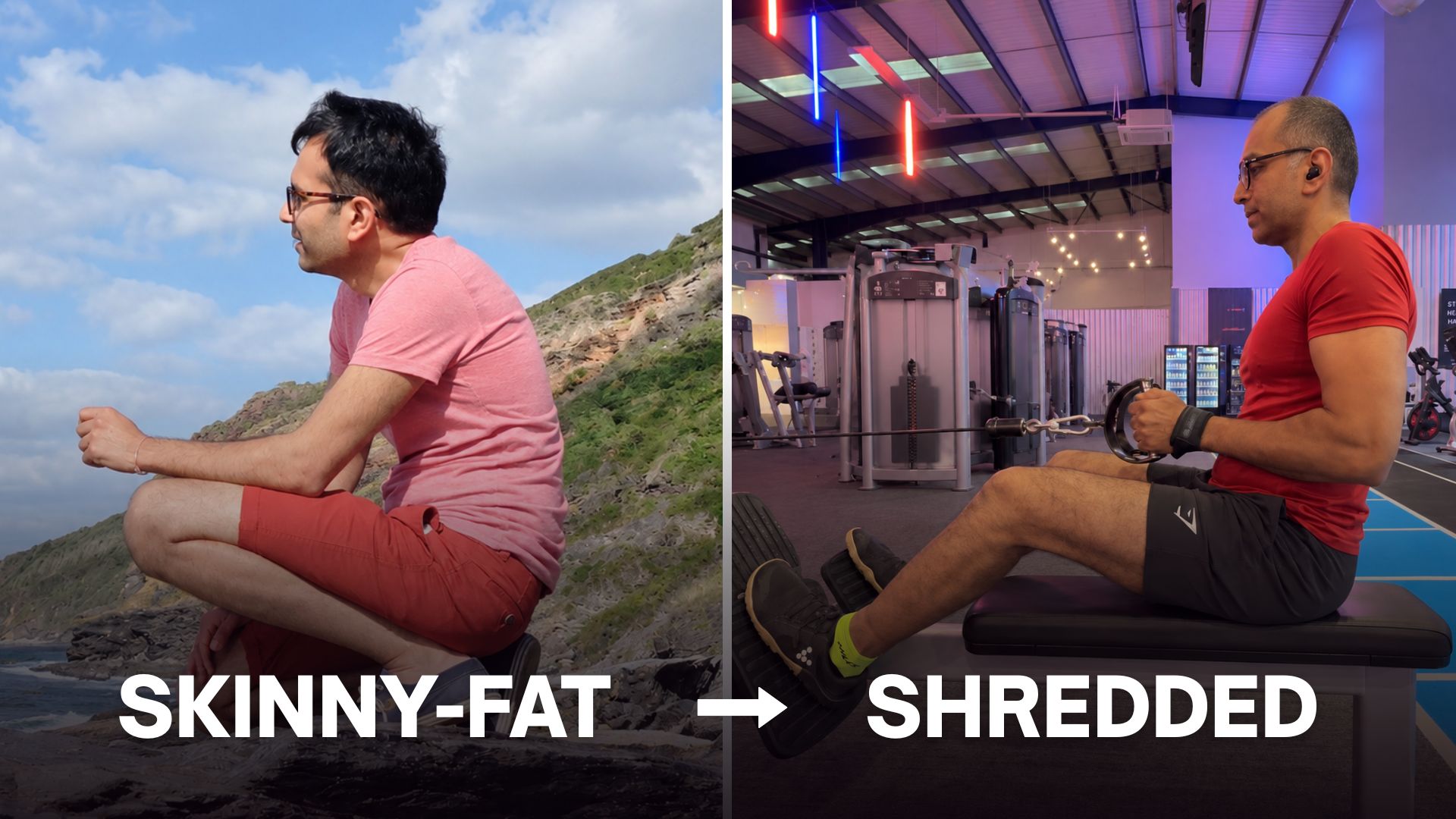
🎧 Listen to Samir’s full story on RNT Fitness Radio:Ep 505 - Hall of Fame | Dr. Samir Patel: Beating Skinny-Fat and Building the Physique He Always Wanted at 45