
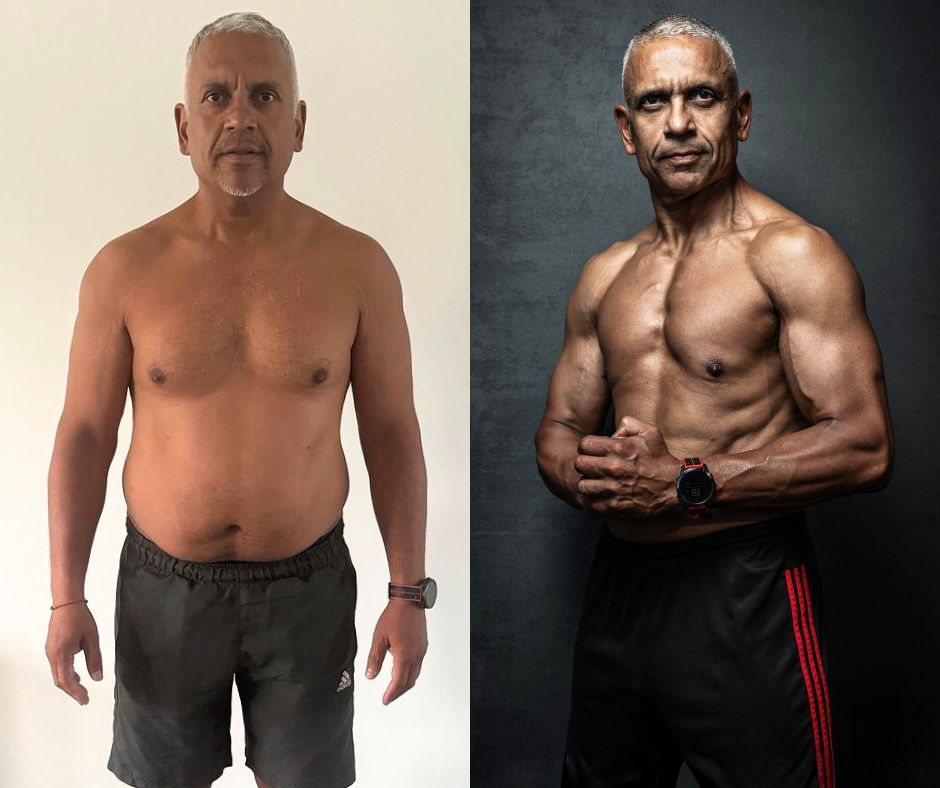
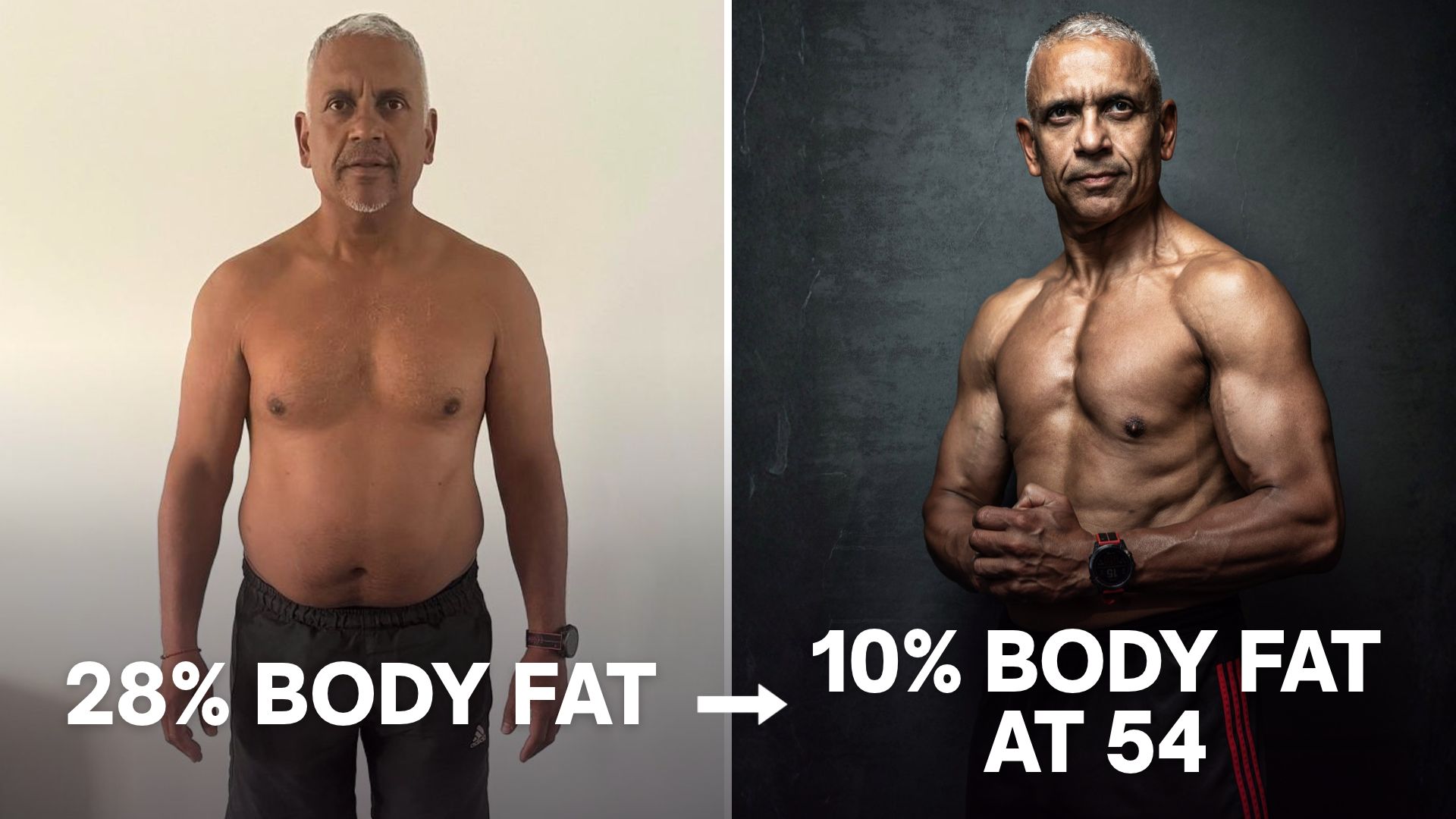
Start: September 2025 - 88kg (~194lbs)
Checkpoint: October 2026 - 72.5kg (~160lbs)
Weight lost: 15.5kg (~34lbs)
Body fat: 28% to 10%
Waist: around 36” to 28-29”
Dipak Hirani has been a squash player and coach for around 20 years. On a family holiday, his daughter told him what she thought.
“My daughter would say to me, Dad, you train so much, but why don’t you look in good shape? You look good, but you can look better.”
“When my daughter’s telling me I don’t look like a coach, wake-up call.”
Dipak started with RNT Fitness on 29 September 2025 at 88kg. At his checkpoint on 30 October 2026, he was 72.5kg, with his body fat down from 28% to 10%.
Blind to His Own Science
Dipak was a gymnast when he was young and played football and cricket. He was the squash coach at Darwin, where they brought in a junior academy, coached for Middlesex and played for Harrow, which he calls the mecca of squash in north-west London. He’s also a padel coach and a Level 3 Personal Trainer. He’s a business consultant specialising in AI analytics. His corporate background is in financial analytics in the telecoms industry, then services and financials.
“As a coach and as a personal trainer, I was never happy with how I looked from a physical perspective. And I think that affected me mentally from interacting with particular clients.”
“I was having periods where I was getting really fit and I was looking OK, and then periods where I would dip, and then my physique would change accordingly.”
In the spring and summer before he joined, he had blood tests.
“My testosterone levels started to dip, so when I went for my bloods, I started realising my muscle mass was going through a little bit of muscle atrophy. I think that was a wake-up call for me post 50.”
He was playing squash, running and rowing. He’d done Kilimanjaro and Mount Toubkal.
“I’d go to the gym and do strength training, but there’d be no structured programme. I’d do some of the lat pulldown, I’d do legs, so there was no structure in my strength training.”
“I just took a step back and I thought, why am I putting weight on and I’m doing all this exercise and climbing mountains?”
On the mountains, he was eating carbohydrate gels and bars.
“I think my carbohydrate intake was at a different level than what I needed, and I wasn’t taking enough protein as well.”
“What About Me?”
Dipak has a 21-year-old daughter and an 18-year-old son. Ten years ago, he says, he was busy dropping them off, picking them up and taking them to tutoring.
“I think it got to the point where I had to say, well, what about me? It’s my time, it’s my journey now, as they’ve gotten older.”
He talked about this at the RNT Breakthrough.
“Sometimes as a coach, you think you know it all. I thought I knew how to change, and that’s the reason I think I had this yo-yo. I was kind of blind to my own science really.”
“I needed another coach to reflect on my nutrition, my training plan, the mental wellbeing, everything around the lifestyle, the hydration, your social engagements.”
Dipak’s brother had a heart attack at 52, post-COVID.
“He looked well, his baseline nutrition was good, and he had a heart attack, and he had stents put into his heart, and I was like, that really threw me.”
“Maybe everything that’s going around me is leading up to this event, where I’m training, I’ve got cortisol, I’m working long hours, my nutrition isn’t balanced. Maybe that’s where I’m heading.”
Dipak sees the same thing in other men over 50, from chasing careers to social circles going down to the local pub, and what he calls the sandwich generation.
“They’re looking after the children, then they’re having to look after the parents, the in-laws, because their health is deteriorating, and so suddenly they’re not focusing on themselves.”
Why He Nearly Didn’t Join
Dipak has known RNT founder Akash Vaghela for close to 10 years. They trained at the same gym between 2017 and 2020. Dipak knew people who had joined RNT, had seen how they looked before and after, and had read Akash’s book.
“It’s international, it’s got different body types, different cultures. I think that’s important to understand, coming from an Indian background.”
The online format almost kept him from joining.
“I’m a personable person, I love people. I didn’t physically meet my coach or physically be in the gym with the coach so we can see my form and technique and give me quick instant changes, which is what I do.”
“I think I’m disciplined enough, and then having the checkpoints, having the daily reviews, checking in every day, having the review at the end of the Sunday, mapping out how your nutrition was, how your sleep was, your hydration, seeing the results come about. That gave me that structure that I think I can make this work.”
A Cupboard of His Own
When Dipak started, he was still working in corporate, in multiple conference calls with India and the US.
“You have a one hour window in your day, and you go into the kitchen, you open the pantry and you think, oh, I want a coffee and I love a toast, and I love a biscuit.”
He says the first few weeks of cleaning the palate forced him to understand he didn’t need to go to the pantry just because he’d come off a call. With teenagers in the family wanting snacks in the house, he split the pantry.
“I separated the pantry out. I said, right, this is my cupboard right now. That was the cupboard I would go to because I would then know there’s not Fruit Pastilles and chocolates and everything else. There’d be alternatives for me.”
He also started weighing his nuts.
“Indians love nuts, right? You’d normally go in and say, oh, I’ll have a little bit of pistachio and almonds and cashew nuts. And then understanding how much that actually weighs and how dense the calories are. When I started being a lot more disciplined on that, the weight started coming off in bigger phases.”
“There’s no quick fix. You put the food in your mouth, you do the exercise, you do the steps. It’s raining, you’re the guy taking yourself out, so you can’t outsource these things.”
Brown Rice Instead of Chapatis
Dipak’s wife is an accountant who looks after the books, so before he started, he had to get her on board financially. At home, the family has Indian food three or four days a week, then Italian, Mexican or a mix of cuisines.
“She would do the cooking in the evening, let’s say she’s making chickpeas and potatoes, but she wouldn’t make my chapatis, so I’d have an alternative, brown rice or something.”
His wife works full time in the city, so Dipak got more involved in the kitchen to make sure his nutrition matched his meal plans. He found visits to his in-laws more difficult. His mother-in-law would load his plate, and his father-in-law was used to having a whiskey with him or going out to an Indian bar. Dipak cut his alcohol intake down drastically.
“I may have a little, small whiskey with him, just to keep him company, but I wouldn’t have two or three pints of Guinness and a whiskey on top… I think it’s the fact that then I want the salty foods, I want the peanuts, I want the crisps, and it’s the added calories that it was bringing on.”
“Come On, It’s Only a Samosa”
Dipak is a Charity Trustee at the Shree Kutch Leva Patel Community (UK), SKLPC. That means meetings and functions, including representing the charity at the House of Commons, where there was a buffet.
“If I have that extra cookie, I’m on the treadmill for 45 minutes.”
In the last six months, people started noticing the change in his face.
“They’re like, you’re falling ill, what’s wrong with you? This is not normal. I think that was the biggest comment I got.”
“It’s like they’re goading you, right? Come on, have an extra samosa, what’s wrong with you, it’s only a samosa, it’s only one onion bhaji, or it’s only one drink.”
At weddings he stayed away from the free bar and had lemonade or soda water.
“I would just say no. I would say I’m on a fitness journey, I’m a coach now, so I have to make sure that I’m in the optimal kind of fitness.”
Sunday Meal Prep and 15,600 Steps a Day
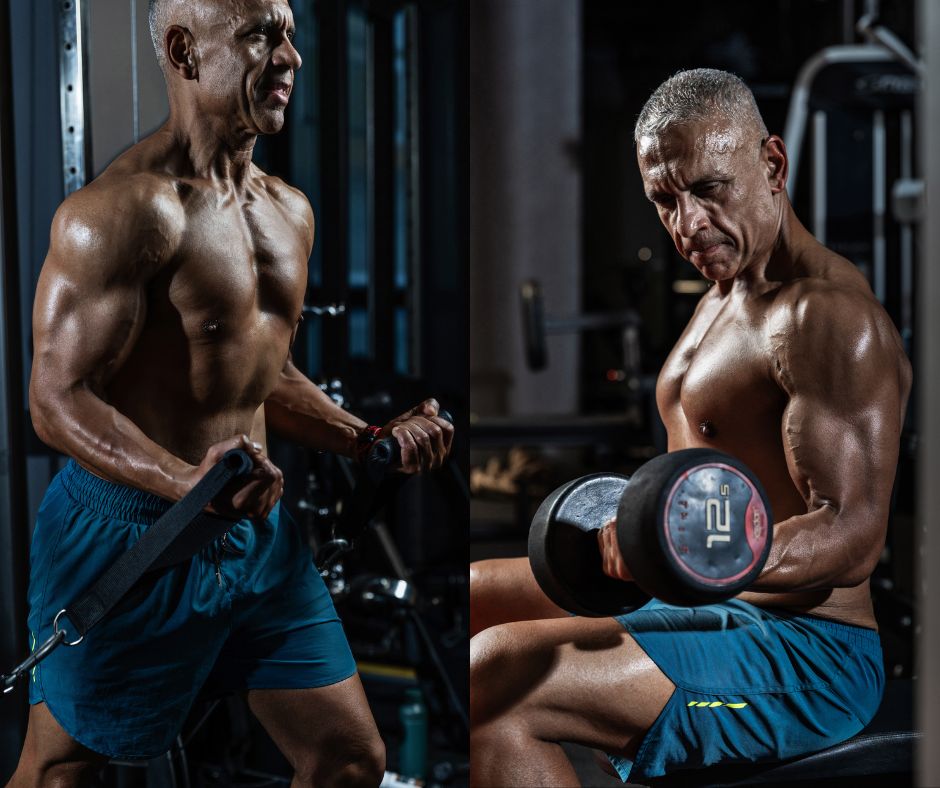
Dipak says training was never a problem for him. He now works as a PT at David Lloyd, where he’s around people training and has access to equipment. He found the meal plan side more difficult. In the last six months, he used tips from Akash’s podcasts and group presentations to start meal prepping.
“On a Sunday I would know what I’m going to have on a Monday, Tuesday, Wednesday, Thursday, Friday, and preparing those meals and making sure I’ve got them in the freezer and in the fridge. I’ve got the ingredients, I’ve got the Fage yoghurt for the evening. That gave me the structure that I needed for the nutrition side.”
He would cook enough protein-dense food, like tofu, to last the week. Over the last 12 months, he did around 5.4 million steps, averaging 15,600 a day.
“Rain, shine, sun, rain. Once you establish your foundation that this is a non-negotiable. That was one of my non-negotiables, definitely.”
“I Don’t Think You’re Ready”
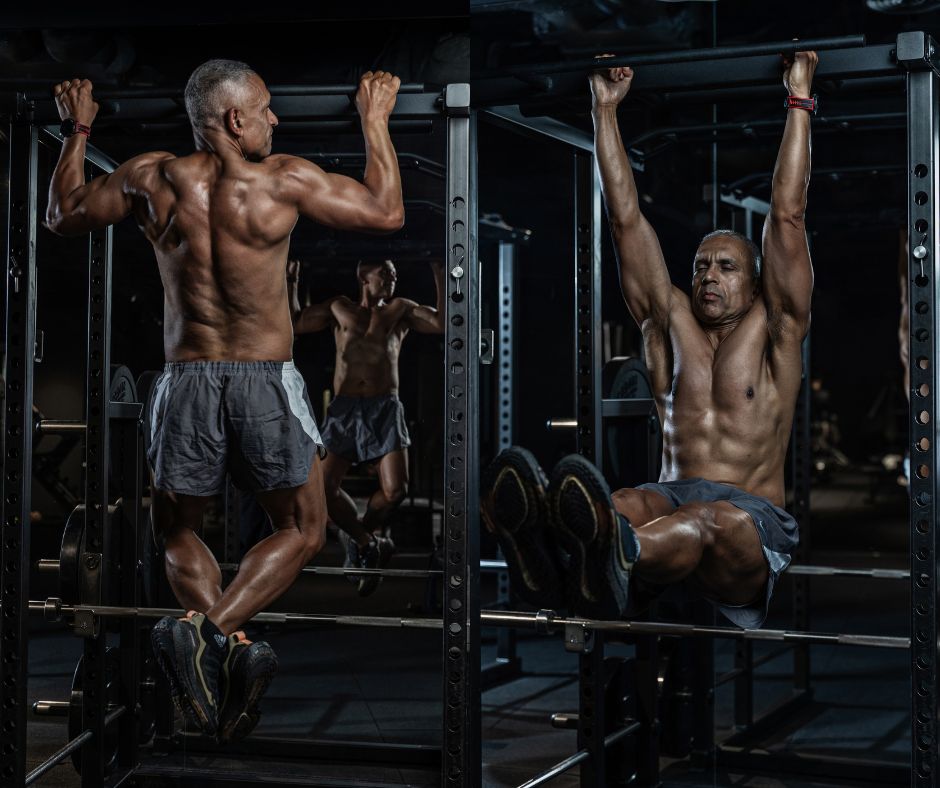
In the last six weeks before his photoshoot, Dipak still wasn’t happy.
“I was waking in the morning, looking at the mirror and thinking, I don’t think you’re ready. I’m gonna be in front of a photographer, and it’s daunting, especially with your clothes off.”
At social occasions over the previous two or three months, people in a shirt, suit or t-shirt had told him he looked great. He was never happy with his abs.
“One thing my coach said is, you need to bulk up in that area.”
Dipak employed one of his friends, a boxing coach at David Lloyd. They did boxing rounds and more core work, on top of his existing training plan.
“He became like another coach I could rely on. And then I got to the point where he said, yeah, I think you’re looking good now. Getting validation from a third party, from another coach, I think that always helps.”
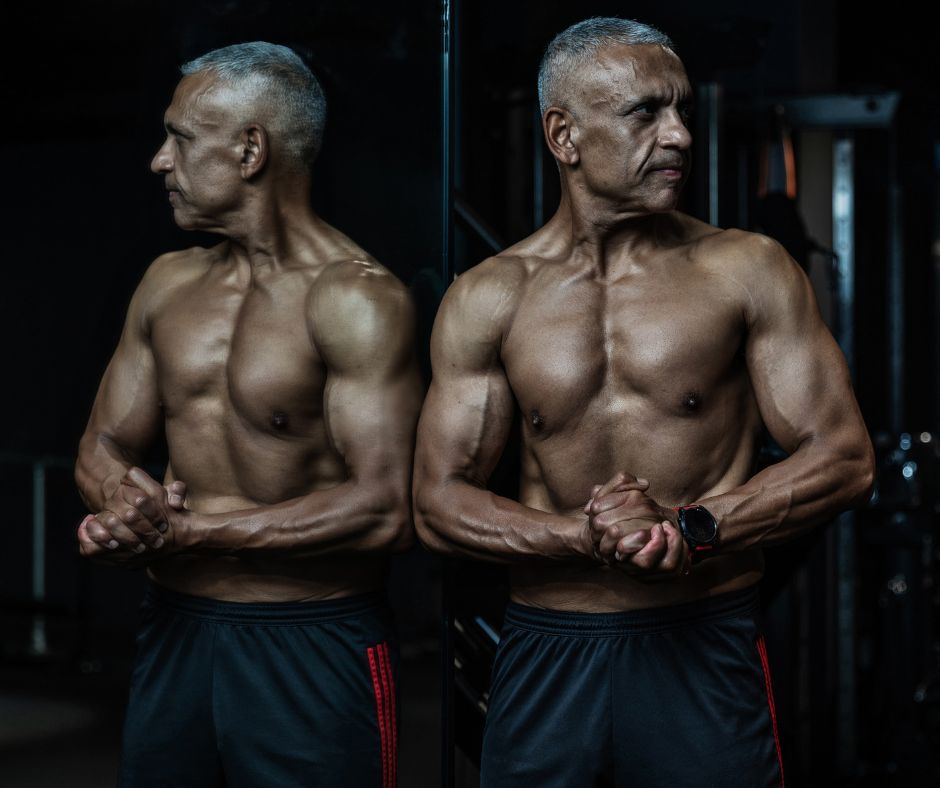
“It’s the journey we all go through, where the face changes, then the shoulders, then the biceps, then the back, and you think, when are my abs gonna change? And suddenly it started clicking and I thought, wow, now I’ve found the formula. I found my own formula to change my own self.”
One comment he kept getting was “you look well head to toe”.
The Strength of a 25-Year-Old
After the photoshoot, Dipak’s bio age on the Evolt machine came back with these results.
“Strength of a 25-year-old, flexibility of a 50-year-old, but my metabolism is of a 37-year-old.”
“I’m actually more muscular now than I’ve ever been.”
Dipak says squash was always about performance on court, and he’d got to the point where his matches were too close. He wanted the strength and agility to win those extra few points. His performance improved drastically.
“I would go on a 10k run and come home and think, have I just been on a 10k run? I could do 15,000 steps, I was doing press-ups and pull-ups, and I was thinking, how am I able to do this?”
“If I’m climbing mountains with 10kg extra weight and I’ve shredded that, now suddenly my ligaments and tendons are not having to carry that extra weight. I’ve never been as strong as I am now in terms of the weight I’m lifting in the gym.”
He can get into jeans he hasn’t been able to wear for 10 years, and a pair of Armanis that were just hanging there.
“We Are Gujarati Men”
Dipak was born in the 70s. Growing up, men in their 40s and 50s looked old to him. Now people tell him he must be in his 40s.
“I’m like, no, I’m 54, I’m gonna be 55. It’s like that shock element.”
“I didn’t want ever to do a vanity thing. I wanted to show that as an Indian male dad, with all the other pressures that we have in life, it’s possible.”
He watched the journey of Akash’s dad, also called Dipak, and the two have been for tea together.
“That helped me as well to say, no, let’s stand up, we are Gujarati men. Let’s not have this perception in society where it’s like, oh, you’re Indian, you can’t get muscular, you shouldn’t have a six pack. Now I think we’ve changed that narrative, and I’m proud to be part of that.”
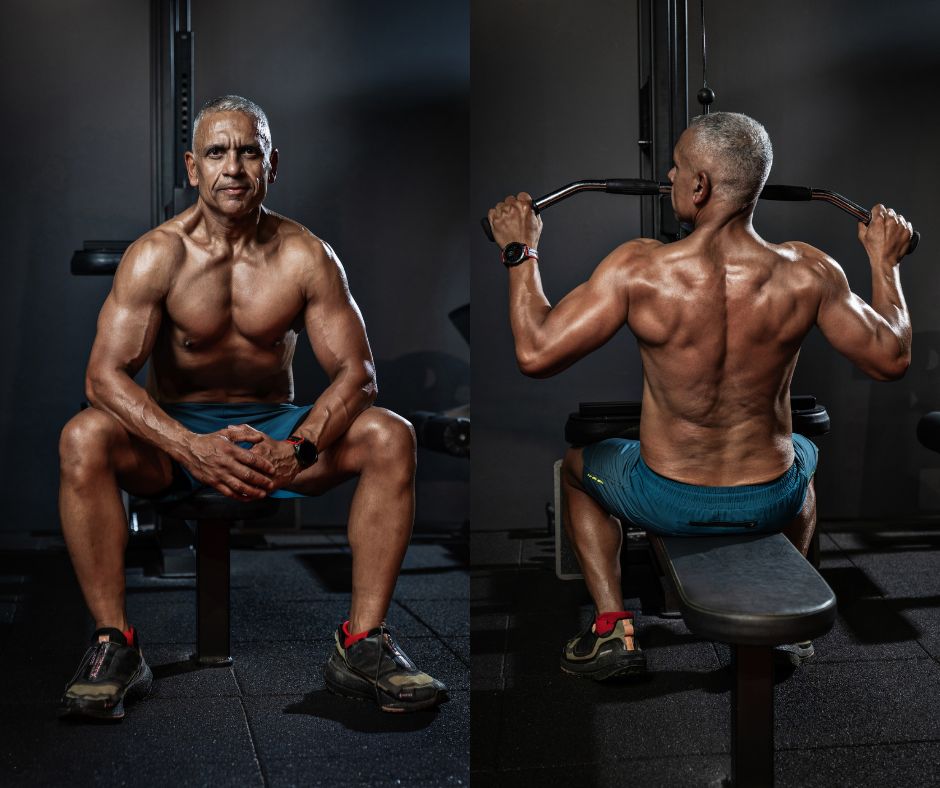
“I can go into the changing rooms, I can walk around David Lloyd, I look like a coach.”
“As a PT now, I’m in the gym, and the 40, 50, 60-year-old Indian man is looking, thinking, wow, this guy is the real deal. He’s showing he can do it, therefore he can help me to do it.”
What’s Next for Dipak
Dipak said he’d be getting a full set of blood tests the following week, looking at his hormone levels and testosterone. His next fitness goal is fell running and trail running.
“I love mountains, I love running, but I’m not gonna run on roads, because I just don’t find that exciting. I prefer going into the woods, trail running and fell running.”
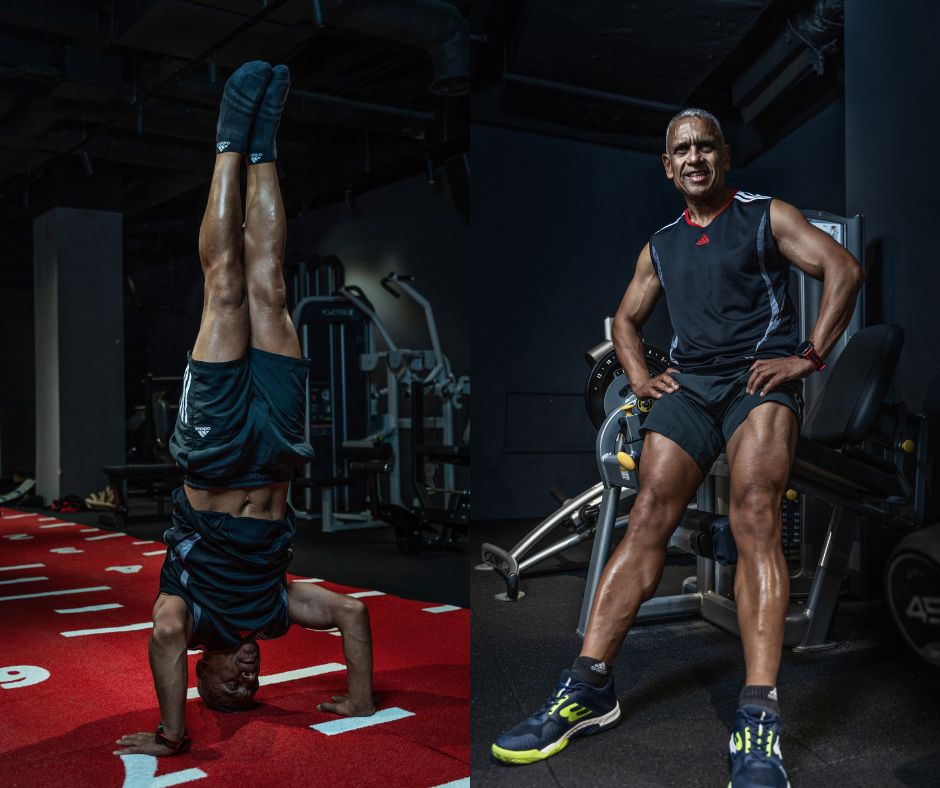
He’s done several spiritual retreats this year, including Tuscany. He’s still a padel coach, still playing padel and still climbing mountains, and he wanted his photos to show that.
“I’m not just a gym guy pumping iron in the gym. I’ve always believed that your physical capabilities and your fitness should be adaptable to everyday life as well.”
His advice to anyone starting out is to do their research and talk to people who have been through RNT, ideally in a similar age group or circumstances.
“There’s always gonna be wedding season, there’s always gonna be Diwali, there’s always gonna be Eid, there’s always gonna be something that’s gonna be a stumbling block in your 365 days a year calendar.”
“I think invest in yourself, and then if you need a vehicle, then RNT’s a great organisation to get on board, and they’ll look after you.”
Want results like Dipak’s?Book a call with our team to start your journey.
🎧 Listen to Dipak’s full story on RNT Fitness Radio: Ep 511 - Hall of Fame | Dipak Hirani: 28% to 10% Body Fat at 54


