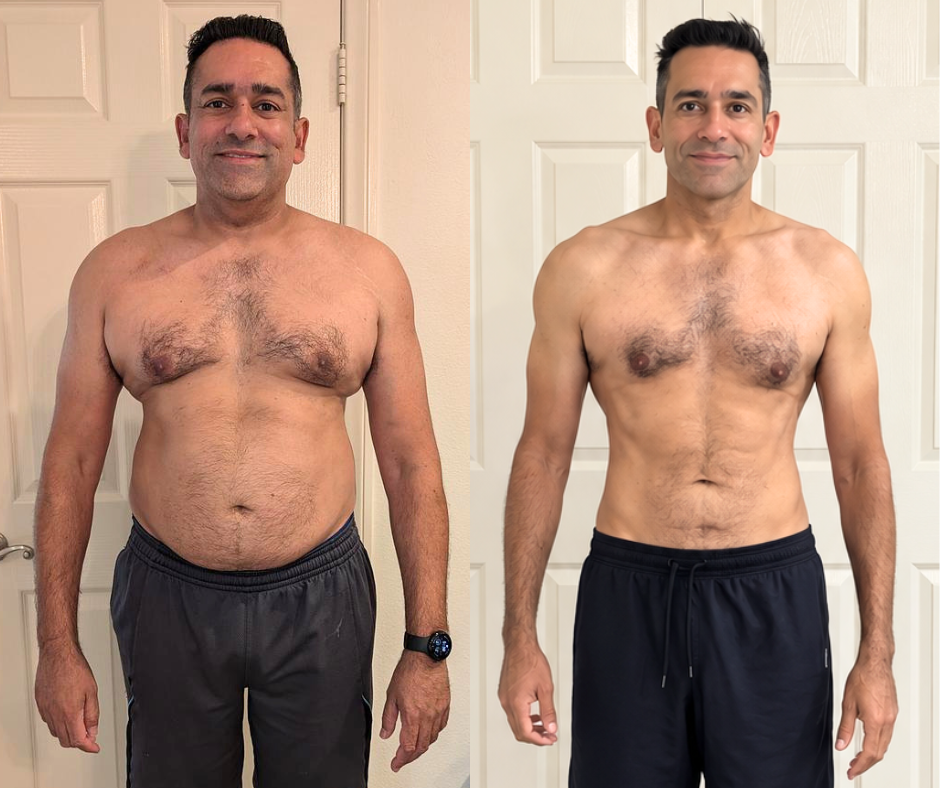
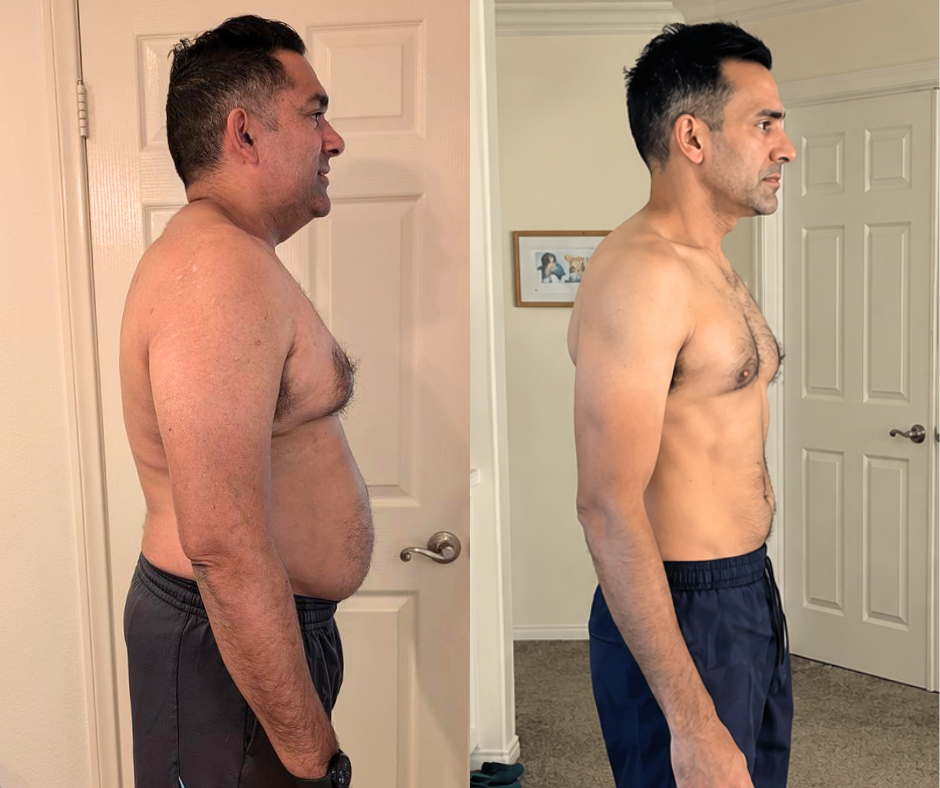
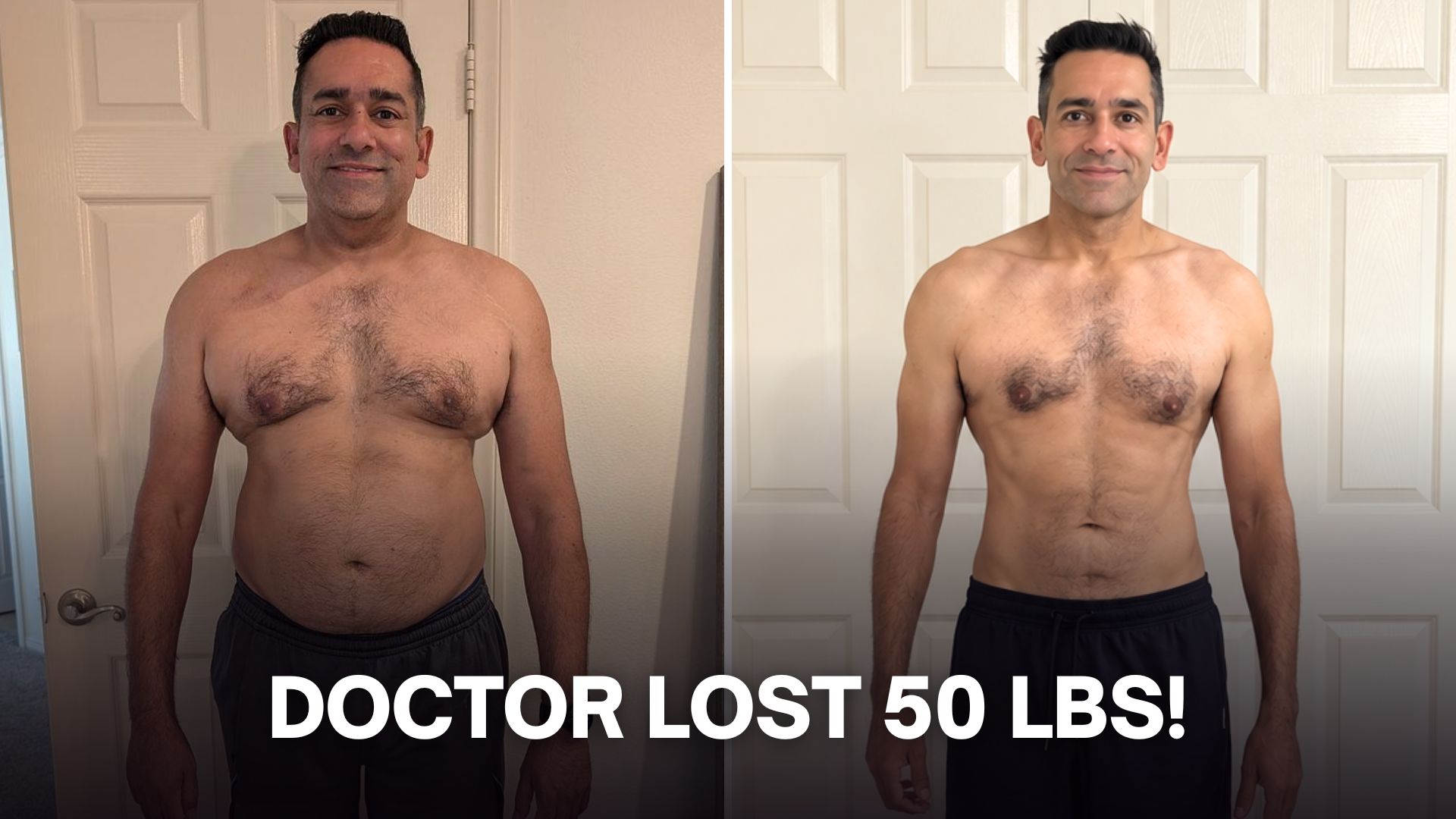
Start: October 2024 - 94.5kg
Checkpoint: February 2026 - 70kg
24.5kg lost (~54lbs)
Ameet Shah has practiced medicine for over 16 years. Family medicine, geriatrics, hospice care. Every day, he tells patients to move more, eat better, sleep properly. He assumed he was already doing it. He lifted weights. He watched his protein. In his own head, the extra weight around his middle was muscle.
Getting Away With It, Until He Wasn’t
Ameet had been in and out of the gym since 2017, when he first decided to build muscle. But the pandemic changed his working life before it changed his waistline. As a physician overseeing his own building, right by the main medical campus, his site became the hub for both COVID and non-COVID outpatient care. He converted non-clinical space into clinical space. Life sped up, and somewhere in that stretch, the weight crept on.
“It was over a five-year stretch that it slowly went up. I didn’t notice it.”
He was vegetarian, and had built his own private logic around what counted as healthy. Protein bars, high in fat but low in carbs. Whole milk. Fruit at the ready. He tracked in MyFitnessPal but only really watched one number.
“I primarily focus on the proteins and minimize my needs for the other groups because I make up, oh, that’s for a normal person. I’m working out regularly, that doesn’t apply to me.”
Patients would comment on his weight from time to time. His wife would mention it gently. He had an answer ready every time.
“I’ve been lifting weights. So I just kind of had an excuse.”
The Comment That Stuck
The moment that actually moved him wasn’t dramatic. An elderly patient, someone he’d seen for years, poked his belly during an appointment.
“You’re getting a little bigger here.”
It sat with him. Around the same time, a colleague at work mentioned she’d just joined a fitness program, a competitor to RNT. Hearing that was enough to tip him over.
“When she said that, I’m like, yeah, maybe I’ll join too.”
He booked a call. It turned out later that his colleague had actually signed up for the wrong program by mistake, and had meant to join RNT herself. The two of them ended up comparing notes on both programs side by side, which only confirmed the decision for Ameet.
What he hadn’t done well, by his own admission, was bring his wife into the decision before he made it.
“I pretty much told my wife, I’m having a consultation. She says, OK, great. And then I had it and I’m starting on this date. Which happens to be 4 days before her birthday.”
He started anyway, on 21 October 2024.
Turning the Whole Family Into the Meal Prep Team
The first weeks were a fumble. Ameet had never made his own food before. Starbucks on the way in, Subway for lunch, whatever his mother-in-law had cooked for dinner. Switching to a structured plan meant actually preparing meals, and it pulled the whole household in.
Over time, the system settled. His kids pre-measure his oatmeal and mix his Greek yogurt containers. His wife makes his lunches for the week. His mother and mother-in-law cook his dinners, usually Indian food built around dal, rice and vegetables, with the oil measured out and spread across several meals rather than one.
“It’s still a team effort where everyone kind of helps me in that journey. I appreciate them helping me out with this.”
Steps were the part that nearly broke him. He was averaging under 4,000 a day at baseline, and his job left almost no natural gaps to add more.
“I’m non-stop, continuously working. I’m seeing patients in between patients, I’m doing emails. I had to just be with my thoughts, and I have other things to do.”
The turning point came when he bought a walking pad for his home office, and later got rid of his desk chair at work entirely.
“By 8:30 in the morning, I’ve already gotten to 7,500 steps. I’ll do my emails or patient messages while I’m going a mile and a half an hour.”
He didn’t hit his target weight by the end of his first year. Rather than call it done, he and his coach decided to run it back for a second year, this time moving out of pure fat loss and into building muscle.
“It’s a different beast the second year. It’s no longer just fat loss. It is now just like how do I build the muscle and get into a rhythm that can be more lifelong.”
He still hates leg day. He’s learned to do it anyway.
“I struggled with Bulgarian split squats from the beginning, and now it’s like, OK, I got this. I didn’t think my knee could touch the floor. I can touch the floor now.”
94.5kg to 70kg, and a Practice That Changed With Him
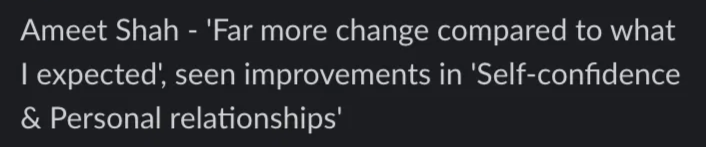
Ameet’s feedback form told his coach the change had gone further than he’d expected, with real improvements in self-confidence and personal relationships. It shows in the small things now. Playing with his kids without needing to lie down mid-afternoon. Carrying them up the stairs. Going to bed by 9:30 instead of grinding through work until 11.
“I have the energy throughout the day every day, so I’m able to do more.”
His daughter, 13, and son, 12, have their own honest verdict on the old photos.
“Look how fat you were before.”
The bigger shift has moved into his exam room. Ameet now sees a steady stream of patients asking about GLP-1 medications, convinced they need a prescription to lose weight. He talks them through what he’s lived himself: that starving the body burns muscle before fat, that carbs fuel the muscle protein builds, that a medication used without resistance training just trades one problem for another.
“I tell them, I’m gonna prescribe this medication, but I also want you to learn how to eat, because you still need to fuel your body. A common side effect is sarcopenia, loss of muscle, because people don’t eat enough.”
He leans on the same explanation he’d give his own coach. Patients who think losing weight means depriving themselves get told to picture the body as a car.
“You gotta put gas in the tank, or you’re gonna feel tired all the time, your muscles are not gonna have a lot of energy.”
When one patient, an RN herself, panicked that a single glass of wine had added a pound and a half overnight, Ameet walked her through what was actually happening.
“How much of that is just your glycogen source? Your weight should go up after you increase your carbs. That’s what your body holds onto as a quick energy source, and you’re refilling it. That’s OK, as long as you’re fueling your body.”
He’s seen the other side of it too. A pair of doctors he spoke with recently told him they’d decided against training altogether, reasoning that medication alone would save them the time.
“You guys are doctors. That’s not a good sign that you’re saying that.”
Because his caseload splits between family medicine and a geriatrics and hospice fellowship, falls prevention sits close to his own reasons for training now.
“I gotta think about falls. I gotta think about how they can still stay independent with time.”
He’s also had to relearn something about himself socially. A self-described “gregarious introvert,” he used to always have a drink or food in his hand at gatherings, a prop to hide behind. He’s since swapped it for water or a diet soda, and cut alcohol down to one glass, once a week.
Colleagues have joined RNT because of him. So has his sister and his cousin.
“There will be people down the road that will try to sabotage you, not intentionally. You’ll hear comments that you almost have to get defensive with. That’s where you have to build that support around you.”
What’s Next
Ameet isn’t chasing a leaner finish line. He’s staying in the same rhythm that got him here, tracking small wins in the gym rather than a specific number on the scale.
“I’ve been slowly trending the workouts. I’ve been able to do one additional rep, one additional rep, and then move on to the next weight. I feel like this is comfortable.”
He’s watching his own habits for the same warning sign he flags in patients chasing quick fixes. Getting too aggressive too fast is usually what unravels a result, not what protects it.
Want results like Ameet’s?Book a call with our team to start your journey.
🎧 Listen to Ameet’s full story on RNT Fitness Radio: Ep 504 - Hall of Fame | Dr. Ameet Shah: 50 lbs Down & Bringing RNT Principles Into His Practice

.png)