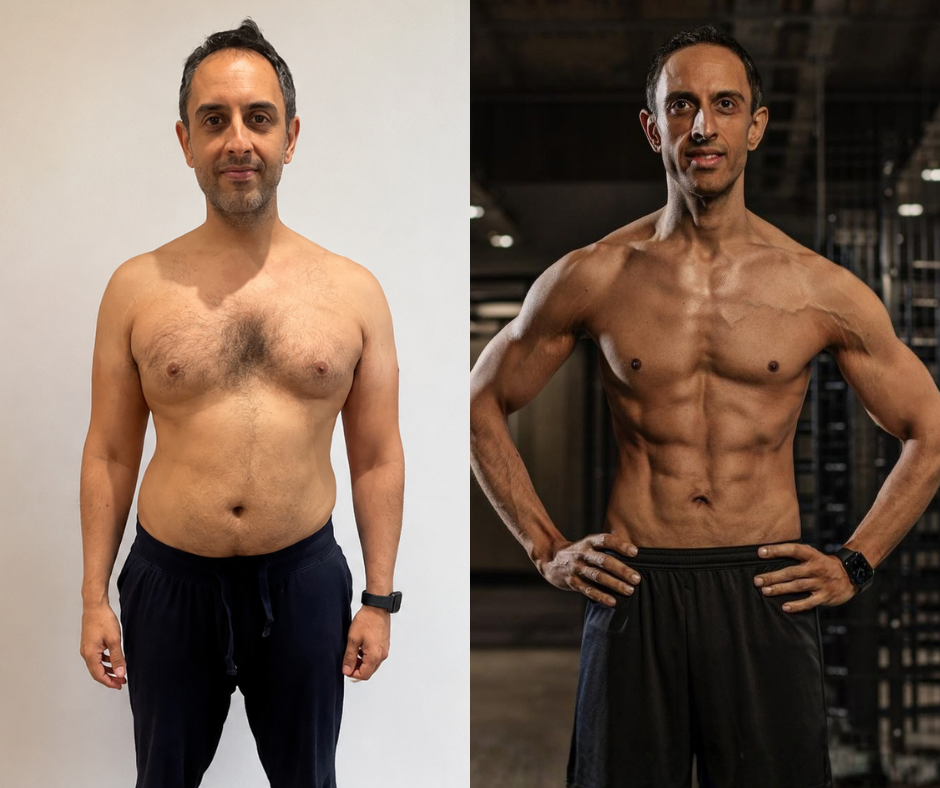
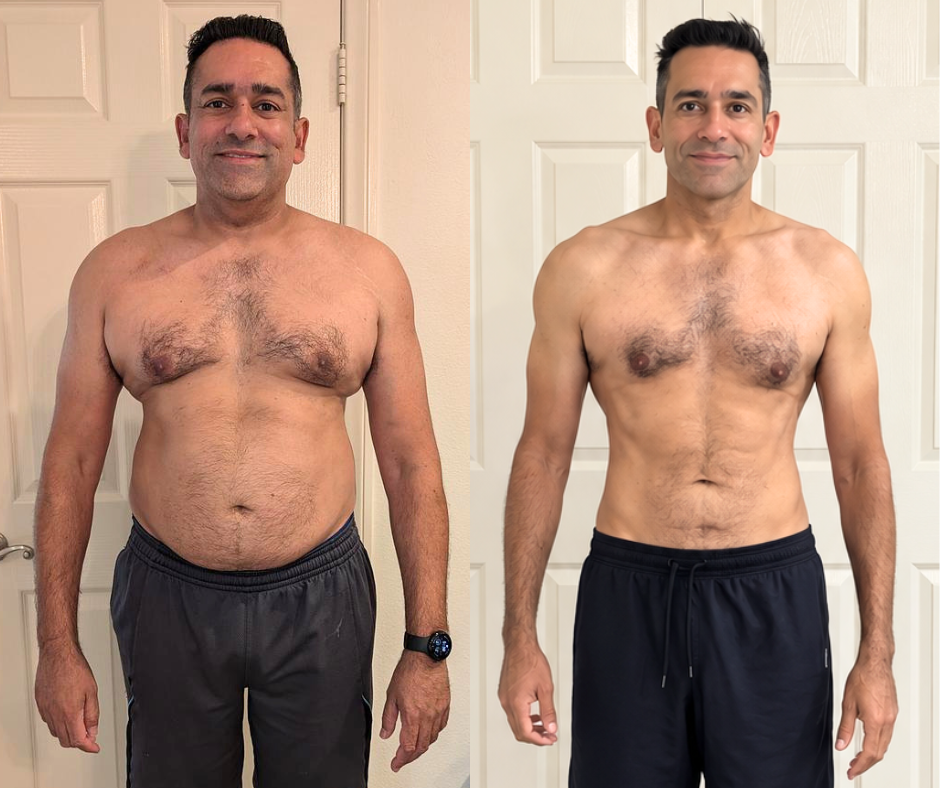
The Messy Middle: The Hidden Phase Between Getting In Shape and Staying In Shape
You lost the weight. Now your body wants it back, and your identity hasn't caught up yet. This is what the Messy Middle is, why most people never escape it, and how to break through for good.
Akash Vaghela
·
Jul 3rd, 2026
MindsetBeginner
38 Mins
Share
When you lose weight, your body is desperate for you to regain it. The physiology is clear. You cannot lose fat cells, they only shrink. When you have smaller fat cells, they are hungry to fill up again. Your hormones, ghrelin (hunger) and leptin (fullness), are fighting you to put it all back on again. Ideally, with a bit more. Fat cells love to multiply. And when you gain weight back fast, they won't hesitate. What happens next is the perpetual yo-yo diet cycle, where every time you attempt to lose weight, it gets that little bit harder, and over the years, you either quit or die trying.
If you can survive the 4-12 weeks after you lose weight, with a clear and structured approach, you will escape an immediate rebound. But short-term survival is not enough. Because the statistics on weight regain over time are staggering. Only 10-17% of people who lose significant weight keep it off long term. Most of the time, 50%+ of weight lost comes back within 2 years.
This doesn't happen in your typical "rebound" fashion. It's a slow and agonising death by a thousand cuts. One day you're in shape. A few months (or years) later, it's like you've never stepped foot in the gym. And not because of a lack of trying. Or because you didn't have the right plan.
In every case, it's ignoring the fact that after we lose weight, our true habits, mindset and identity lag behind. This psychological "catch up" takes longer than we expect, so over time, as humans love to do, we drift into what we like to call the Messy Middle. In this article, my goal is to break down what the Messy Middle is, why it happens, and how to break through to being in shape for life: The Reward Phase.
What Is The Messy Middle?
The Messy Middle is when you have changed physically, but not yet internally. The psychological lag makes you feel "off", whereby you're living one foot in the old world and one in the new. At its root, it's an identity evolution, which feels like an identity crisis. And because you are not in the new world yet, you feel like you need to make sacrifices to enjoy what the new world brings.
Let's bring this into a tangible example with your body composition. You've gone from 80kg down to 60kg. You've avoided the initial rebound, and now you're trying to figure out how to stay near 60kg, but it's feeling f*cking hard. The reason is you have a 80kg brain in a 60kg body.
And there's a reason that lag is so brutal. The motivation that stripped the weight off was never really you. It was borrowed. You had a deadline, a wedding, a holiday, a shoot, or just a "I need to get my sh*t sorted" line in the sand, and a deadline amplifies urgency in a way that makes you act like a different person for however many weeks it takes. Every week the scale moved. Every week you saw something in the mirror you'd never seen before. That's not an identity. That's a sprint fuelled by a countdown. So when the countdown ends and real life settles back in, the borrowed motivation evaporates and you're left standing there asking: now what? I haven't got a plan. How do I actually hold this? That question is the doorway into the Messy Middle.
So you begin to experience:
Guilt for enjoying food again, especially when outside your routine.
Fear of losing your hard earned progress.
Confusion around your priorities and purpose in your wider life.
A split identity, where you're still acting like your "old self" in some environments.
The split identity is the biggest battle. Before losing the weight, you may have loved going down to the pub with your friends and ordering five pints. It's what you and your friends did. Six months and 20kg later, you will face the devil on your shoulder screaming at you to order five. Both because your friends are still doing it, and because old habits die hard. Your brain doesn't know how to reward you yet by drinking only one, without the previous motivator of a weight loss goal.
More examples include:
Attending social events (birthday parties, weddings, BBQs) and being unsure what to eat/drink without guilt.
Going on holiday and compensating with extra exercise, and/or unnecessary behaviours like carrying food scales (because you don't trust yourself).
"Adherence" to your "plan" feels forced; and you still feel like you go "on" and "off".
Becoming a "fitness person" whereby exercise, clean eating and "living the fitness life" is a coping mechanism for avoiding the real changes required in life.
When you are in the Messy Middle, you do not want to go back to your old ways, but you do not know yet how to make the new way feel natural, and effortless. This is a natural part of transformation. The danger is you get stuck inside because of a failure to accept the work you must now do.
If you want to know what being stuck actually feels like from the inside, it's this: you're treading water, swimming as hard as you can, and all that effort is buying you is the right not to drown. No forward motion. Just exhaustion to stay in place.
And it gets worse, because your eyes lie to you. When you've just come out of your leanest condition, your sense of "lean" is warped. One kilo above your lowest and your brain screams I'm getting fat. I see this constantly, someone in great shape, photos looking strong, numbers looking healthy, convinced they're failing. The mirror has recalibrated to an unsustainable baseline, and now reality looks like decline. It isn't. It's just the distortion talking.
What 99% of people do in this situation is give up. They would rather try something new, go on another diet, and blame "life getting too busy" to worry about this. The problem is it will masquerade as continued yo-yo dieting for the rest of your life. The good news, you can break through.
Here's a thought that should reframe how you see the whole fitness industry. Think of every person who got shredded, did a couple of bodybuilding shows or a single photoshoot, and now spends their time online telling everyone that "getting lean is bad for you" and "shredding wrecked my relationship with food." We tend to believe them. But in most cases the problem was never getting in shape. The problem was that they never got out of the Messy Middle. Their journey ended in no man's land, and they've spent the years since rationalising it. Don't mistake their exit for wisdom. They quit at the hardest part and called it a lesson.
The Messy Middle Quadrant
When you lose weight, you are running away from the pain of not looking or feeling like you want to. When you have lost it, you will now run away from the idea of gaining it all back. That keeps you stuck in the Messy Middle. There's four questions we need to answer about our identity.
1. Internal Identity Shift
The first is how you view yourself.
Do you still see yourself as out of shape?
Do you still fear certain foods, or outfits, or situations?
Who are you when you're not dieting, and "on a plan"?
Who do you want to be a year from now?
When you view yourself as someone who is healthy, fit and in shape, the transition becomes easy. The answer when you look in the mirror must be your core truth, else the old identity will pull you back with its appealing ways.
This is the section where most articles go abstract and leave you with nothing to actually do. So here are two exercises that force the shift out of your head and onto paper.
1. The first is the sentence: "I am someone who does..." or, easier to start with, "I am someone who does not..." Fill it in honestly.
"I am someone who doesn't hit snooze. I am someone who doesn't skip workouts. I am someone who makes their own food choices instead of caving to whoever's at the table."
You're not describing a fantasy version of yourself, you're naming the behaviours that define the person you've decided to be.
2. The second goes deeper. Take a page, write your desired identity at the top, "a healthy lifestyle" will do, then split it down the middle. Left column: the do's. Right column: the don'ts. Then play the game of opposites and watch your real habits appear in black and white.
"I manage stress without reaching for food" sits opposite "I eat a bag of chips after every bad meeting." "I make my own choices" sits opposite "I give in to peer pressure."
It's uncomfortable to see it laid out. That's the point. Now you know exactly what you're becoming and exactly what you're leaving behind.
There's a trap to name here, and it has a face: the "big guy." For a lot of men, being out of shape isn't just a body, it's a personality. The joker, the one who's always got a pint and seconds at dinner, the one taking the mick out of himself first so no one else gets there. When the big guy stops drinking five pints and stops going back for thirds, it's not just a diet change, it's the death of a character he's played for twenty years. The fear underneath "who am I if I'm not the big guy?" is real, and you have to meet it head on. You can be the same warm, funny, magnetic person without the body that came stapled to it.
The female version of this trap usually runs the opposite way, and it's just as dangerous. It isn't a character she's afraid to lose, it's an impossible standard she's trying to add. The great mum, the successful career, the lean body, the spotless health, the social butterfly who never misses a thing, all of it, all at once, and all looking effortless. And here's where it bites: the fantasy isn't that she does it all, it's that she does it all without changing how she currently behaves. That's the lie. You genuinely can have it all, but the price is becoming someone new. "Effortless" is the dangerous word, because it means "no change required," and change is exactly what's required. You can't keep the old behaviours and expect the new body and new life to appear alongside everything else. So have it all. Just understand you have to behave like the person who has it, every day, on purpose, until it's simply who you are.
And here's the encouraging part. You don't start this from zero. The fact that you reached your leanest condition at all is proof, hard, banked evidence that you can act like a different person. Every time you act in line with the new identity, you add to the pile. The bigger the pile of proof, the easier the new identity is to believe. It's not a leap of faith. It's a balance that compounds.
2. External Identity Shift
The second is how others view you. Most transformations fail due to comparison, pressure and the stigma around living and looking a certain way. Most of your circle is out of shape, so when you lose weight, it's a threat. If you didn't battle this on the way down, you must now recalibrate. This is where you see relationships break down, careers change, and social circles die down. When you've spent 20 years building a life in a specific way, this is where you must systematically audit the external ties to see if they still fit your desired way of being.
There's a phrase for what happens here: crabs in a bucket. When one tries to climb out, the others pull it back down. It's rarely malicious. Your old circle just liked who you were, and your change is an unspoken accusation about who they still are, so they reach for the pint, the box of chocolates at Christmas, the "go on, one won't hurt," before you've even sat down.
The sharpest version of this lives in the household. I ran a workshop in New York where a man stood up and described exactly this: his transformation had opened a chasm between him and his wife. He wanted to keep pushing into the new identity. She didn't want to come with him. And the gap was now causing real conflict. He hadn't yet had the one honest conversation that could close it, which is its own fear, and we'll get to it. But understand the scale of what's at stake. This isn't only about friends offering you beer. It can reach the most intimate relationship you have.
The other side of recalibration is loneliness. When you step out of the old circle and haven't yet found the new one, there's a stretch where you don't know where you fit, you don't know who your tribe is yet, and the path of least resistance is to get pulled straight back so at least you belong somewhere. Expect that gap. Don't let it be the reason you retreat.
The fix is not to convert everyone or win an argument. It's twofold.
First, plant the seeds early. While you're still losing the weight, you tell the people close to you that this isn't a 12-week project, it's how you live now. Then, when you hit your goal and they ask "so I guess you're done?", you've already laid the ground.
Second, be relentlessly true to the new identity in front of them. You can't control how they see you, but over time, as they watch you stay consistent, the version of you in their heads updates to match the version in yours, and then the pint stops appearing unasked. It takes time, especially with people you see rarely. Be patient and be consistent.
3. Lifestyle Balance
Your shape of life will not be the same as your shape for life. You must break this association. If you get into truly lean condition, your shape for life will likely be 10-15% above your lowest. If you get into okay shape (but no visible six pack (male) or toned lines down your stomach (female)), it may be 1-5%. This margin changes because you lack the muscle mass to go any higher, and if you do, you will not be happy with how you look and feel.
(This article, How Heavy Will You Be When Lean, will give you good reference points as to what truly lean condition is. If you kid yourself with how lean you get, you will end up frustrated. It's better to be honest with yourself so you know the right range thereafter to live within.)
The answer here is to figure out: "what bodyweight range feels effortless forever?" I call this finding the sweet spot between optimal and sustainable. The faster you find this, the quicker you can build your lifestyle to further support the range. As opposed to forcing a range, and the restrictive nature of life it will demand you live.
But how do you actually find that range? You have to flip the entire way you think.
Getting lean ran on one logic: here is the goal, now what must I do to hit it? You picked the destination and bent your life to reach it. That works for a sprint. It's poison for a life. Post-checkpoint, you turn the equation upside down: what am I genuinely willing to do, week in and week out, forever, and what body does that give me? You start from the inputs and you accept the output. Not the reverse.
The reason most people stay stuck is they refuse to make this flip. They look at some jacked guy or a woman in amazing condition and say "that's what I want," and that wanting is fine. But what that person did to get there is something they will never sign up for. They want the 100% body on roughly 30% of the inputs. And it's not even an effort problem. They also want a great career, a family, meals out twice a week, yoga three times a week, all genuinely good things for a genuinely good life, and then a professional athlete's physique stapled on top. It doesn't add up. It never adds up.
So make peace with the trade that actually works: the 80% body, with the life you want, beats the 100% body you'll never put 100% into. And here's the part that surprises people. That 80% body is far better than it sounds. Stay in a sensible weight range, train consistently and progressively for two or three years, and especially if you're still holding newbie gains, your physique transforms anyway. You take the pressure off, and the results stack up regardless. The 80% body, given time, stops looking like a compromise.
4. Goal Recalibration
When fat loss is achieved, your definition of success must change. If you hang on to staying too lean, or fall into the trap of having no goal, then requiring a diet to regain shape because you drifted, it won't end well. Most people will never redefine what success in health and fitness looks like, so will remain in a never ending mini yo-yo dieting cycle.
So what do you aim at instead? Here are real targets, not platitudes.
If you want to get stronger, take your big compound lifts, squats, hinges, presses, rows, pulldowns, get clean baseline numbers, and chase roughly 20-25% on those lifts over a year (same reps, same good form). Six months, call it 10-15% if you're properly on it. That's not a fantasy. For most people at this stage, it's simply doable.
If cardio lights you up, work toward a milestone: couch-to-5K if you've never seen yourself as a runner, then 5K to 10K to half marathon. I'd flag the half marathon as the sensible ceiling. Beyond it, running starts eating your whole life. Or pick an event with a date on it: a hike, a HYROX, a Go Ruck. The date is the point. Accountability in the calendar pulls your consistency up on its own. I've watched a member's training effort go through the roof the moment an event got booked in.
Then layer it. Pair one performance goal with one job: hold a tight bodyweight range, say a 2kg window. One thing to get better at, one number to stay inside. Do that for a couple of years and you genuinely won't recognise yourself.
One warning that overrides all of the above: pick something you actually care about. Everyone hits their goal, realises they have less muscle than they thought, and decides "right, I'll build muscle." But if lifting weights doesn't excite you, that's a bad goal for you. Keep training for your health, sure, but don't hang your motivation on it. If the thing doesn't grip you, the novelty wears off and you let it go. Trial and error is fine here. You might book a few things you end up hating before you find the one that pulls you back week after week.
How To Break Through The Messy Middle
Time alone does not fix identity. It is not enough. If it was, then by default our statistic would flip around. 10-17% of those who lose significant weight don't keep it off.
Think of it as time multiplied by focus. Passive time barely moves the needle no matter how much of it passes, while active time compounds.
Passive time is when you refuse to face any of the four shifts and just let the calendar roll. It looks productive from the outside. You white-knuckle a deficit Monday to Friday on pure motivation, then blow it out over the weekend. You become the new you on your own and the old you the moment you're with anyone else, a split personality stretched across a seven-day week, permanently annoyed at the person you were yesterday. Weigh yourself daily and you'd see the truth: peaks and troughs on a weekly rotation, going nowhere. So you stop weighing yourself, because the scale won't tell you what you want to hear. You can hack this for a long time, six months, a year, longer, slowly gaining, slowly burning out, until one day the mental exhaustion wins and you say f*ck it and quit completely. That's not a maintenance strategy. That's a slow-motion relapse with extra steps.
Active time is the opposite. It's deliberate. You decide who you're becoming, then you put yourself in the situations that test it, on purpose, with your eyes open. That's what this Four-Step Exposure Loop is for:
1. Expose (trigger): Put yourself in real-life situations (meals out, social events, holidays)
2. Awareness (action): Observe your triggers, thoughts, and decisions in those moments.
3. Reflect (truth): What did you learn? What would you do differently next time?
4. Repeat (life): Keep looping until the behaviours of the new identity become automatic.
Exposed At The Mexican Bar
Social events are the biggest triggers in the Messy Middle. I see many people fall into the trap of avoiding real life scenarios. They'll say no to events they wish they could go to. They'll make a big deal out of the fact they took their own food to a friend's house. Or they'll use holidays as an excuse to get 20-30,000 steps a day. This is very common behaviour in the Messy Middle.
This is where it gets tricky, because "breaking through" to the Reward Phase is not as linear, specific or tangible as first getting in shape. It's why I like to say it takes 2-3 years (at a minimum) of active work, around the Exposure Loop, to make significant progress. That allows for different seasons, calendar events and also, for the real life sh*t to happen and test what you do.
You must, and I cannot state it enough, put yourself in multiple environments, with multiple emotional states, during all times of the year. This is the hardest part of transformation. This is the rewiring. Every inch of your brain will want to revert to old behaviours because it "feels good" and of course, to "live a little".
But restriction is not the goal. Exposure is. You're learning to be someone who can go out, eat freely, and stay aligned with your goals.
The Messy Middle reveals two types. The first is the overly restrictive person who is fearful of food, whereby they miss meals out, look down on people eating out, or not living the way they think they want to. The second is the all or nothing person who will swing from one extreme to another (yo-yo dieting).
A good example of putting the right steps forward in the Messy Middle is an example from a Mexican Bar. The Old You: orders a burrito with nachos, sauces and dessert. 2000+ calories later, they're racked with guilt and over compensating the next day with exercise/diet.
The New You: enjoys the burrito, has a few chips (not all) with a couple bites of dessert. No guilt or desire to "make up for it."
Heck, when you make it to the Reward Phase, you'll have the 2000+ calories and not give a f*ck because you know one meal doesn't matter.
And this doesn't only apply to restaurants and parties. The same loop runs on the vices no one else sees, the bag of chips with Netflix every night, the snacking that kicks in the second you're alone. Expose, notice, reflect, repeat. Work through each one systematically until it loses its grip.
So if we know we must go through these four steps, why don't we?
4 Fears In The Messy Middle
As with any change, fear blocks progress. In the Messy Middle, there's four which rear their ugly heads. If you don't lean into it, you will stay stuck.
1. Fear of Losing Progress. You must raise calories and accept Shape for Life weight is not the same as your Shape of Life weight. It will feel like you're going backwards, but the reality is if you hold onto your leanest condition, you are in a state of permanent dieting. You will never find your "sweet spot". It is not a healthy place to be, physically or mentally. Now of course, this is not an excuse to gain weight fast. It's finding and accepting your "sweet spot" based on your lifestyle desires.
2. Fear of Redefining Priorities. You have only ever known two things: being out of shape, and being in shape. What's caused you to be out of shape, and struggle with being in shape, is a lack of honesty with your priorities. You have to get clear on your values, and what you want. If you've done the process right, they will not be the same as before. But if you ignore this step, and fail to crystallise them, you will drift back to before.
Here's how you test what your priorities actually are, rather than what you claim. Anyone reading this will say health and fitness is in their top three. Everyone says it. So don't ask yourself. Ask your bank account and your diary. Where does your money actually go? Where does your time and your focus actually go? Your spending and your calendar don't lie about your priorities the way your mouth does. If the honest audit doesn't match the words, you've got two choices: change how you act, or admit it isn't really a priority. Both are progress. Pretending is not.
3. Fear of Hard Conversations. You are one honest conversation away from a big breakthrough. The Messy Middle will force you to confront your choices in work, career, spouse, relationships and lifestyle. Everything will be under the microscope. If you examine and do nothing with what you don't like, you will stay stuck. I see people stay stuck for 30 years over a conversation which could be over in 30 seconds.
The thing that finally forces the conversation is reaching the point where staying as you are becomes genuinely intolerable. Not uncomfortable. Intolerable. Until then you'll keep escaping into other things rather than saying the hard thing. Look at how many people settle into marriages, jobs and circles they don't want, for years, for decades, because the 30-second conversation feels scarier than the 30-year sentence. Whether it's a conversation with a partner, a friend, a boss, or just with yourself in the mirror, you already know what it is. Everyone does. You just have to go and have it.
4. Fear of Slowing Down. This may be the first time in your life progress is not linked to your scale weight. If you've yo-yo'd all your life, that's the only fitness metric you know. Especially for women. Progress now means internal growth, or new performance metrics. The Messy Middle means learning to value "maintenance mastery". That is a goal in and of itself. Too many play maintenance down, but in fitness, there may be no greater achievement. If you have aspirations to build muscle, strength and cardiovascular fitness, then you must be realistic with what they are as they pertain to your values, priorities and lifestyle balance.
Brace for how much slower it feels. In the fat loss phase the scale dropped weekly and the photos changed fast, you could lose a serious chunk of your bodyweight across a single year. The new goals don't move like that. Adding 25% to a lift over twelve months is a real, hard-won result, but next to weekly fat loss it can feel like nothing. That contrast is the trap. The new pace isn't failure, it's just the actual rate these things move at. And it ties straight back to lifestyle balance: if you train three times a week with dumbbells in your living room, you can build genuinely good muscle and real strength, just don't measure it against the bodybuilder you follow on Instagram. Match your expected rate of progress to your actual inputs, and the slower pace suddenly feels like the fair trade it is, instead of a constant sense of being short-changed.
Time In The Messy Middle
I've seen "perfect breakthroughs" happen in about 18-24 months. This is rare. The "typical breakthrough" in a focused person is 24-36 months. Unfortunately, most people don't ever make it. At the root, one or two things will always hold them back, so they can never let go of the associated vices, coping mechanisms, or behaviours. It's usually relationship or career related, which of course are major life decisions. But if this were easy, I wouldn't be writing this. It's going to be painful.
Our Head Coach, Ed, on Ep 453 of RNT Fitness Radio is open about getting stuck here himself, a solid six months in the Messy Middle after getting into proper shape for the first time, and he'll tell you it was the low point of his entire fitness journey. There's a counterintuitive lesson in his case. He didn't start from a badly overweight, painful place, which sounds like an advantage, but it meant he had less pain pushing him forward. The further you've fallen, the harder the floor shoves you back up. If your starting point was only "a bit soft," you'll have to manufacture that drive deliberately, because it won't be handed to you by how much you hated where you began.
The only people I see break through are those who are absolutely intolerant of their current situation. They have an emotionally charged desire to make it into the Reward Phase. They are the ones who are honest with what and who they want their identity to be. They use a combination of the pain of staying where they are, whilst pulling themselves forward by connecting to their Future Self.
Most will have an idea of this Future Self Ideal. But most will continue to massage this as a fantasy and never make it. It's only built through consistent action. You are what you have committed to, and unless the action is pointing in the right direction, the identity change desire will be a lie.
And the fantasy isn't harmless. When you've declared who you're going to be and then keep living as who you are, the gap itself becomes a source of stress. Every day you fail to close it chips at your self-esteem and feeds the spiral, so the unlived vision doesn't just fail to help you, it actively drags you down. The Future Self is only worth having if it's connected to action today. Otherwise it's not a vision. It's a stick to beat yourself with.
The Monotony of the Messy Middle
Here's the hidden reason why this phase is hard. It's boring, repetitive and comes with minimal dopamine spikes. Most will experience a "is this it?" moment when they're in it. Goals which once sounded exciting, and now boring. This is why drift is so common. And why the desire to actually change your life is often a mere fiction you fantasise about.
Ego appears in the Messy Middle as a friendly companion to tell you you're further ahead than you think. Ego will tell you you're crushing it, you're "there" and you've nailed it. But what Ego stops you looking at is the fact you've created a "I'm a fitness guy/gal" persona.
The antidote is accountability: self, peer and expert-led.
You must be willing to be honest with yourself (self).
You must be willing to change and lean into your relationships/community (peer).
You must be willing to take direct feedback from an outsider who will not tolerate your stories.
Most people live the same life 60 years in a row from the moment they graduate from school. It's the same monotonous slow death where you never challenge the beliefs, stories and identities you hold so close to yourself, and you're tangled up with.
When you get into the best shape of your life, you have a unique opportunity to turn everything on its head. To stop your initial change being a "one off fitness thing" to a catalyst of total transformation.
Expect to question everything. Accept nothing. And in the process of building your "sweet spot", creating the life you, deep down, truly desire and love.
The Reward Phase
When you're in the Reward Phase, you are no longer on a fitness journey. You won't have goals like "fat loss" or "building your body" or "doing X in the gym". You don't feel the need to share your story. Nor do you talk much about fitness. It becomes intuitive, effortless and not something you gotta think about doing.
You don't "count macros" or have "non negotiables". All the things you do to get into shape slowly slide away. Now you might be thinking "so how do you stay in shape if you have no structure, strategy or system?"
Therein lies the question. Because once you stop asking it, you know you're there.
Akash Vaghela
Akash Vaghela has spent 10+ years transforming bodies and lives around the world, and in May 2017, founded RNT Fitness to serve this purpose. His vision is to see a world transformed, where ambitious high performers experience the power of the physical as the vehicle to unlock their real potential. He’s the author of the Amazon best-selling book Transform Your Body Transform Your Life, which explains his unique and proven five-phase methodology, is host of the RNT Fitness Radio podcast, has been featured in the likes of Men’s Health and BBC, whilst regularly speaking across the world on all things transformation.


 Akash Vaghela
·
Jul 3rd, 2026
Akash Vaghela
·
Jul 3rd, 2026